
How to price white label software: monthly fee, setup fee and packages by niche

To price white label software, start with the floor (what the platform costs per client, your time and the fees to get paid), set the monthly fee based on the value the system delivers, decide whether to charge a setup fee and organize everything into 2 or 3 packages per niche. The right price sits between your floor and the value the client sees.
In this guide you'll see how to calculate the floor, the 3 ways to reach the monthly fee, when a setup fee is worth it, a package model with worked examples and the mistakes that most often eat into the margin of anyone reselling a system under their own brand.
First, the floor: what each client costs you
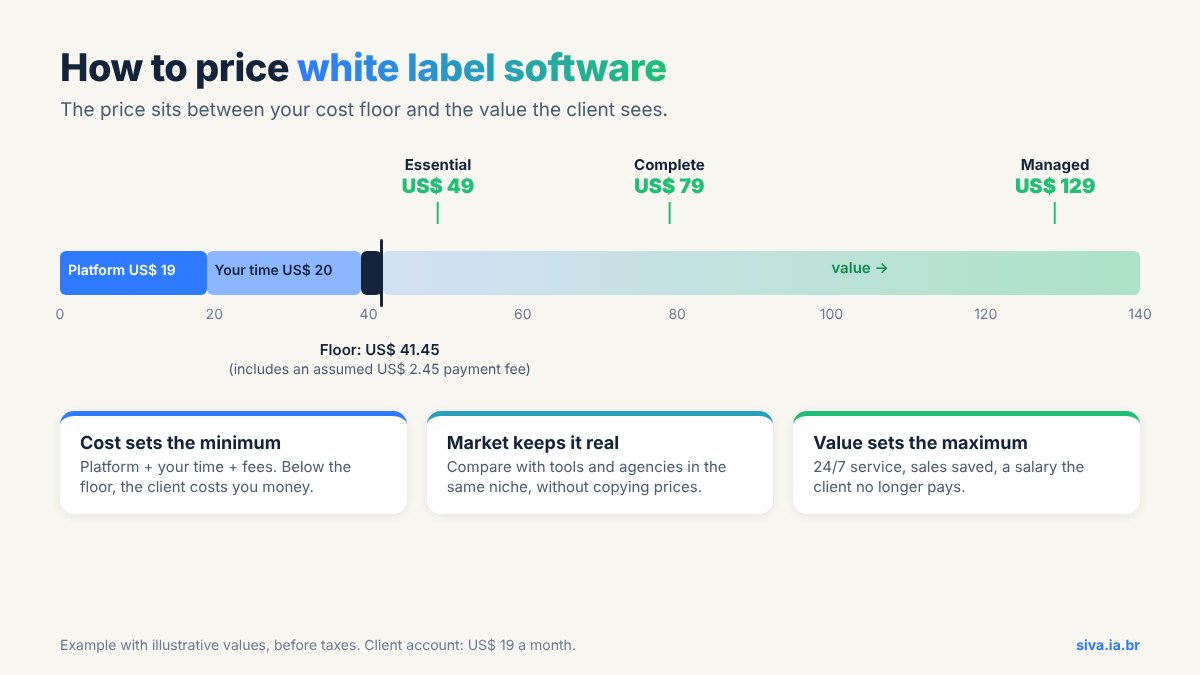
The floor is the amount below which you're paying to work. It has three parts: the platform cost per account, your monthly time with that client and the fees to get paid.
| Cost item | Example per client | How to estimate |
|---|---|---|
| Platform (client account) | US$ 19 | What the provider charges per active account |
| Your time (support, tweaks, reporting) | US$ 20 | Example: 2 hours a month at US$ 10 an hour |
| Fee to get paid | US$ 2.45 | Example: an assumed 5% fee on a US$ 49 payment; check your provider's real fee in your country |
| Floor per client | US$ 41.45 | Below this, the client costs you money |
Your time weighs as much as the platform: if you charge US$ 49 and forget the support hours, you think you make US$ 30 per client when, in practice, about US$ 7.55 is left. Example values, before taxes.
Another part of the floor is the minimum number of accounts. In the SIVA partner program, for example, the invoice charges at least 5 accounts (US$ 95 a month). While you have only 2 clients, each one carries part of the 3 empty accounts. So your launch price has to work at this early stage, not only once your portfolio is full.
How to set the monthly fee: cost, market or value
| Method | How it works | Watch out |
|---|---|---|
| Cost plus margin | Floor divided by (1 minus the margin you want) | Simple, but ignores what the client gains from the system |
| Market-based | Look at what similar tools and agencies charge | Copying the price of a different service leads to the wrong price |
| Value-based | Compare with what the system replaces or brings in sales | Requires knowing the client's routine; that's where the margin is |
Cost-based example: with a floor of US$ 41.45 and a 40% margin, the math is 41.45 divided by 0.6, which comes to about US$ 69 a month.
Value-based example: a clinic that loses patients because nobody answers at night can gain more from a single appointment saved per week than it pays for the month. A store that pays someone just to answer price questions on WhatsApp compares your monthly fee with that salary. In the sales conversation, talk about this result (24/7 service, customers who came back, a full schedule), not about the license.
In practice, use cost to find the minimum, value to find the maximum and the market only to stay grounded in the reality of the niche.
Setup fee: charge it, spread it or waive it?
Setup is the work at the start: building the knowledge base with the client's prices and rules, connecting WhatsApp, tuning the AI's answers, adding the team and training whoever will use it. This work is real and takes hours.
| Option | When it makes sense | Example |
|---|---|---|
| Charge it separately | Client with many products, rules or agents | Example: US$ 150 one-time |
| Spread it into the monthly fee | Small client who balks at an upfront fee | Example: US$ 15 more per month for 12 months |
| Waive it | Launch campaign or referred client | Agree on a minimum contract term in writing |
With SIVA, partners pay no entry fee and no setup fee. So whatever you charge for setup is all yours and pays for your time configuring the client's account.
Tip: If you waive the setup fee in exchange for a minimum term, put it in a simple contract with your client. Contract and consumer rules change from country to country, and this guide is informative: it doesn't replace a lawyer or an accountant.
Packages by niche: what changes from one to the next
When every account already comes with the full system, what sets one package apart from another is your service: how much of the setup and follow-up is on you. Three tiers are usually enough; more than that confuses the client.
| Package (example) | What you deliver | Monthly fee (example) | Left per client before your time |
|---|---|---|---|
| Essential | Account set up, AI answering with the client's knowledge base, support by message | US$ 49 | US$ 30 |
| Complete | Everything in Essential plus a monthly review of the answers and one campaign a month | US$ 79 | US$ 60 |
| Managed | Everything in Complete plus a monthly report, pipeline and follow-up of people who stopped replying, reviewed with the owner | US$ 129 | US$ 110 |
What's left is the monthly fee minus the US$ 19 account, before taxes and payment fees. In the higher packages, also subtract the extra hours you'll put in. And note that Essential, at US$ 49, is only a little above the US$ 41.45 floor from the first example: it only works if it takes very little of your time.
For each niche, change the pitch and the examples, not the system. For clinics, talk about booking through the chat and reminders; for stores, about catalog, orders and payment links; for real estate, about answering ad leads right away. If you already run ads for clients, see how to fit the system into your offer in white label for marketing agencies.
Mistakes that eat into a reseller's margin
- Charging too little to close fast: a low price attracts clients who ask for a lot of support. Raising the price later is much harder than giving a discount.
- Charging per message: the client doesn't know how much they'll pay and is afraid to use it. A fixed monthly fee is easier to sell and to collect.
- Forgetting the usage limit: each SIVA account has 1,000 AI replies per month. For a client with very high volume, agree in advance on what happens.
- Forgetting Meta's cost: on the official WhatsApp API, Meta charges per message separately, with prices that vary by country. Make it clear in the proposal who pays that bill.
- Discounts with nothing in return: if you give a discount, ask for something back, like annual payment, a minimum term or a referral.
- No plan for price increases: agree from the start on when and how the price is reviewed.
How to present the price in your proposal
- Start with the client's problem, in their words: unanswered messages, customers who disappear, an overloaded team.
- Show the result: 24/7 service, orders or bookings through the chat, follow-up with people who stopped replying.
- Present the packages from the most complete to the simplest. The first price becomes the reference.
- Separate setup and monthly fee on different lines, with what's included in each.
- Close with the payment terms: payment method, due date and what happens if a payment is late.
To see how these numbers turn into income with 5, 10 or 30 clients, read how much you can earn reselling AI customer service. And once you close, organize your billing with the guide how to charge clients automatically as a reseller.
With SIVA, you set the price and keep the difference
In the SIVA partner program, each client account costs US$ 19 a month, with no entry fee and no setup fee, and you decide how much to charge each client. You start with a pack of 5 accounts (US$ 95, which already covers their first month), paid by card through Stripe. Each account comes with the full SIVA under your brand: an AI agent on WhatsApp 24/7, multiple team members on the same number, catalog and orders, booking through the chat, sales pipeline and campaigns.
- Price and due date for each client set by you
- Client billing through your own Mercado Pago in Brazil, Mexico, Argentina, Colombia, Chile, Peru and Uruguay; elsewhere, record payments with “Received elsewhere”
- Summary of received, pending, overdue and profit (clients minus SIVA)
- Your brand on the system: name, logo, colors and your own address
FAQ
How much should I charge for white label software?
Somewhere between your floor (platform cost, your time and payment fees) and the value the system delivers to the client. Start with cost to find the minimum and use perceived value to reach the final price.
Should I charge a setup fee?
It's worth charging when the client has many products, rules or agents, because setup takes hours. For small clients, you can spread it into the monthly fee or waive it in exchange for a minimum term agreed in writing.
Is it better to charge per message or a fixed monthly fee?
For small businesses, a fixed monthly fee is easier to sell and to collect. Usage-based pricing makes the client afraid to use the system and takes more work to check.
How much does each client cost in the SIVA partner program?
US$ 19 per client account per month, with a minimum invoice of 5 accounts (US$ 95), in US dollars and paid by card. The partner sets the price and keeps the difference.