
Resell, be an affiliate or build your own SaaS: which is worth it in 2026

There are three ways to make money with software: be an affiliate (you refer and earn a commission), resell under your own brand (white label: you set the price and the client is yours) or build your own SaaS (you develop and maintain everything). For people who already serve small businesses, white label reselling is usually the middle ground: it starts fast, with little investment, and the client portfolio stays with you.
In this guide you'll compare the three side by side, see when each one is worth it, what few people tell you about building a SaaS, an example with the same goal of 10 clients on all three paths and 5 questions to choose yours.
The three paths side by side
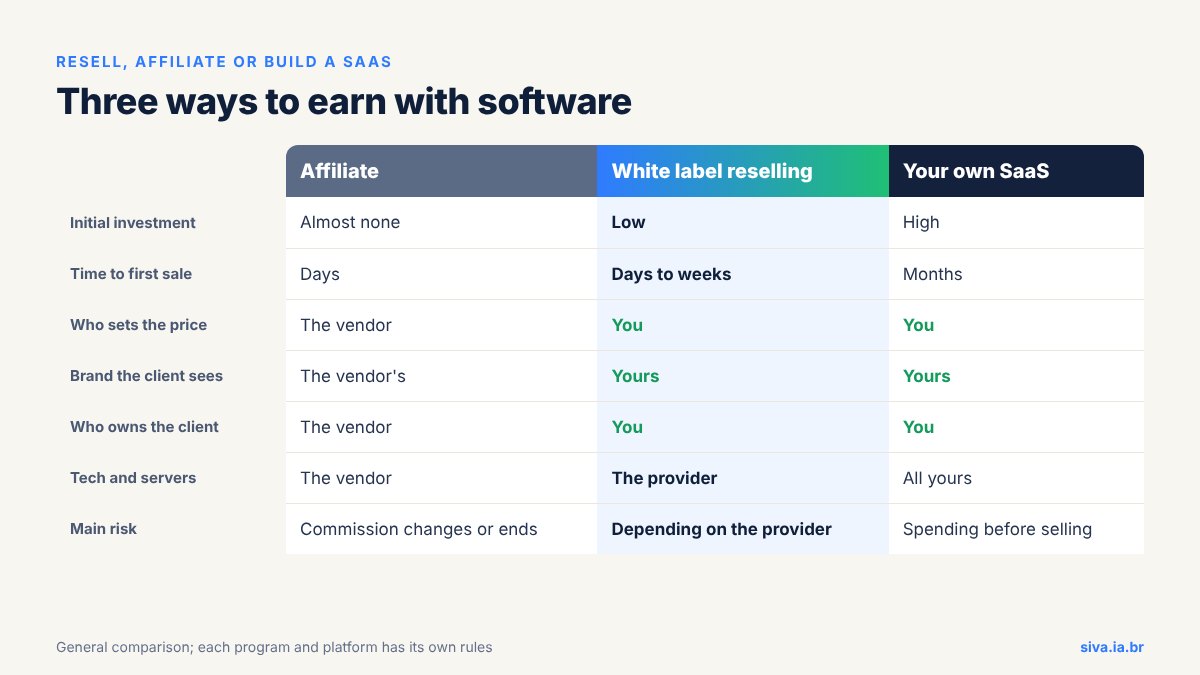
| Criterion | Affiliate | White label reselling | Your own SaaS |
|---|---|---|---|
| Investment to start | Almost none | Low (the platform's starter pack) | High (development, servers, tools) |
| Time to first sale | Days | Days to weeks | Months |
| Who sets the price | The vendor | You | You |
| Brand the client sees | The vendor's | Yours | Yours |
| Who owns the client | The vendor | You | You |
| Customer support | The vendor's | Yours day to day; the technology is the provider's | All yours, including technical support |
| Main risk | The commission changes or the program ends | Depending on the provider | Spending a lot before you sell |
No path wins on everything. The choice depends on four things you already have today: money to invest, time, access to clients and technical skills.
Being a software affiliate: when it's worth it
An affiliate shares a link and earns a commission when someone subscribes. In software programs with recurring commissions, the range cited as the market standard is 20% to 30% of the monthly fee, paid for as long as the client keeps subscribing, according to a guide by Tapfiliate (an affiliate program platform).
It's worth it if:
- You have an audience (blog, channel, social profile, email list) and don't want to serve anyone.
- You want to test whether a product sells before committing to it.
- You don't have time to onboard and follow up with clients.
The catch: the client belongs to the vendor. You don't set the price, you don't sell your service alongside it and, if the program changes the commission or ends, your income goes with it. For people who visit the business, set things up and follow up, the commission usually pays little for the work you actually do.
Reselling software under your own brand: when it's worth it
With white label reselling you pay for the system per client account and sell it with your name and your price. The provider takes care of the technology; you take care of sales, onboarding and the relationship. The model is explained from scratch in what is white label software.
It's worth it if:
- You already serve small businesses (agency, media buyer, consultant, IT support, accounting).
- You want to sell the system together with your service: setup, content, ads.
- You want the client portfolio to be yours and grow under your name.
- You don't want to write code or maintain servers.
The catch: there's a fixed cost per account and, usually, a minimum number of accounts. In the SIVA partner program, for example, it's US$ 19 per account per month, with a minimum of 5 accounts. If a client pays late, you still pay the provider; that's why you should organize billing from day one. See how to charge clients automatically as a reseller.
Building your own SaaS: what few people tell you
Having a system that's all yours gives you the most control and can be worth more in the long run. It's also the longest path. Before you start, add up everything that comes after the code:
- Ongoing development: the system needs fixes and new features all the time, because the market changes.
- Servers and tools: hosting, database, email delivery, monitoring and backups.
- Third-party costs: in AI customer service, there's an AI model cost for every reply, plus Meta's rules and pricing for anyone using the official WhatsApp API.
- Security and data protection: you start storing your clients' customers' data, under laws such as GDPR in Europe and local data protection laws elsewhere.
- Support and uptime: if you charge every month, you need to be online every day.
- Billing and late payments: issuing, charging, reconciling and checking every payment.
People who have been through it often describe the start as slow: recurring revenue grows little by little while the workload is heavy, and simple software is easy to copy. Building is worth it if you have technical skills (or a technical co-founder), money for a few months without returns and a problem that ready-made platforms don't solve.
Example: the same goal on all three paths
Example with simple numbers, before taxes and fees, just to compare the logic. Goal: 10 small businesses using an AI customer service system that costs US$ 49 per month.
| Path | Comes in per month | Goes out per month | What's left |
|---|---|---|---|
| Affiliate (25% commission on US$ 49) | US$ 122.50 in commissions | Nothing fixed | US$ 122.50 |
| White label reselling (you charge US$ 49 and pay US$ 19 per account) | US$ 490 | US$ 190 | US$ 300 |
| Your own SaaS (you charge US$ 49) | US$ 490 | Servers, AI, tools, support and your development time | Depends on the costs, and only after months of investment |
Reselling leaves more than the affiliate path because you set the price, and your client pays for the work of onboarding and follow-up. With your own SaaS the margin may be bigger in the future, but only after you pay for the road to get there. The simulation with 5, 10 and 30 clients is in how much you earn reselling AI customer service.
How to decide: 5 questions
- Do you already have access to small businesses? If so, reselling tends to pay more than a commission.
- Do you want to serve clients? If you don't want to onboard or support anyone, being an affiliate is lighter.
- How much can you invest before you sell? Little: affiliate or reselling. A lot, for months: your own SaaS becomes an option.
- Do you, or a partner, code and want to maintain a system for years? Without that, your own SaaS ends up depending on third parties anyway.
- What is the market missing? If a ready-made platform already solves your clients' problem, building from scratch means redoing what already exists.
You can also combine them: start by reselling under your own brand, learn the niche, build the portfolio and only then decide whether it's worth building something of your own for what's missing. Media buyers, for example, already generate the leads and can sell the customer service that turns leads into sales; see white label for marketing agencies.
Tip: This guide is informational and does not replace an accountant or a lawyer. Affiliate commissions, reselling and selling your own software may be taxed and contracted differently; check with an accountant in your country how to register your business before you start.
White label reselling with SIVA: start with 5 accounts
If reselling is your path, the SIVA partner program gives you a complete AI customer service system for WhatsApp under your brand: no coding, no servers to rent and no entry fee. It's US$ 19 per client account per month, starting with 5 accounts for US$ 95 (which already covers their first month), paid by card through Stripe. Once you pay, your brand is created automatically and your access arrives by email, with the panel and emails in English or Spanish. You decide how much to charge each client, and the difference is yours. See what the system does on the SIVA home page.
- A complete system to resell: AI on WhatsApp 24/7, multiple agents on the same number, catalog and orders, scheduling, pipeline and campaigns
- Your brand on everything the client sees, with your own address (app.yourbrand.com) and emails sent from your domain
- Partner panel with your clients, AI usage, alerts and a team of up to 20 admins
- Client billing through your own Mercado Pago in Brazil, Mexico, Argentina, Colombia, Chile, Peru and Uruguay, or recorded as "Received elsewhere" in other countries
FAQ
What makes more money: being an affiliate or reselling software?
When you resell, you set the price and keep the difference, so the margin per client is usually higher. In exchange, you pay a fixed cost per account and handle support for your clients.
Is it worth building a SaaS in 2026?
It is for people with technical skills, money for months without returns and a problem that ready-made platforms don't solve. Otherwise, reselling is usually the fastest start.
How much does a software affiliate earn?
It depends on the program. For recurring commissions, the range cited as the market standard is 20% to 30% of the monthly fee, for as long as the client keeps subscribing.
Do white label software resellers have to provide support?
Yes, day-to-day support for your clients is yours, because they know your brand. The technology, servers and updates stay with the provider.
Can I start by reselling and build my own system later?
Yes. Reselling first helps you learn the niche and build your portfolio; then you can decide whether it's worth building something of your own for what's missing.
Do I need a registered business to resell software?
To invoice the monthly fee, you usually need to be registered as a business or self-employed, depending on your country. Check with a local accountant.