
What is white label software and how does it work (explained simply)

White label software is a system built and maintained by one company (the provider) that another company (the partner) sells under its own brand: its name, logo, colors and web address. The end client uses the system as if it belonged to the partner, while the provider keeps taking care of the technology, the servers and the updates.
In this guide you'll see who does what in this model, the difference between white label, reselling, affiliate programs and franchises, what carries your brand and what doesn't, how white label is usually priced, the advantages, the risks and who it makes sense for.
White label software in practice: an example
Example: a marketing agency serves 15 small businesses. The clients ask for help keeping up with WhatsApp. The agency doesn't want to write code or become a tech company. It signs up for a white label AI customer service platform, names it ReplyPro, adds its logo and colors, connects the address app.replypro.com and starts selling the system at its own monthly price.
To the client, the system belongs to the agency: the login, the emails and the invoices all carry its brand. Behind the scenes, the provider keeps the system online, fixes bugs and ships new features for everyone.
Tip: The name comes from a plain white label: a product with no brand, ready to receive the label of whoever sells it. In Spanish it’s called "marca blanca", and you'll also see "rebrandable" or "private label" software.
Who does what: provider, partner and end client
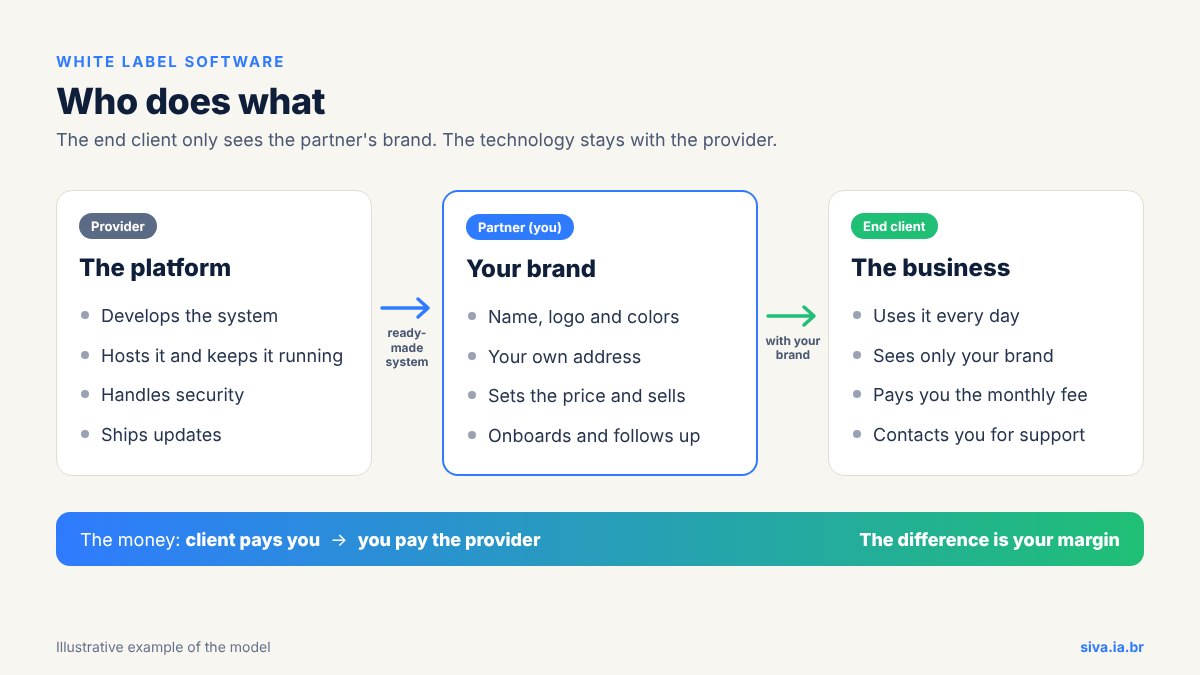
| Who | What they do | What they don't need to do |
|---|---|---|
| Provider (the platform) | Builds, hosts, secures and updates the system, and bills the partner | Sell to the end client or appear to them |
| Partner (you) | Adds the brand, sets the price, sells, onboards and follows up with clients | Write code, rent servers or hire a tech team |
| End client | Uses the system every day and pays the monthly fee to the partner | Know who the provider is |
The business relationship has two layers: the client pays the partner, and the partner pays the provider. The difference between what you charge and what you pay is your margin. In the SIVA partner program, for example, the partner pays a fixed amount per client account and decides alone how much to charge each client.
White label, reselling, affiliate and franchise: the difference
All four models let you earn money from something you didn't build. What changes is the brand the client sees, who sets the price and who owns the client.
| Model | Brand the client sees | Who sets the price | Who owns the client | How you earn |
|---|---|---|---|---|
| White label | Yours | You | You | The difference between what you charge and what you pay the provider |
| Traditional reselling | The manufacturer's | Usually the manufacturer suggests the price list | You, but tied to the manufacturer's brand | A margin or discount on the price list |
| Affiliate | The manufacturer's | The manufacturer | The manufacturer | A commission on sales that came through your link |
| Franchise | The franchisor's | The franchisor standardizes it | The network | The unit's profit, after the fees set in the contract |
In a franchise, the franchisor licenses its brand and its method, and many countries have specific franchise rules, such as handing over a disclosure document before the contract is signed. White label works the other way around: the brand is yours, and so is the way you sell.
In short: as an affiliate you refer, as a reseller you sell someone else's brand, as a franchisee you run someone else's brand, and with white label you build your own. The comparison with investment and time to the first sale is in the guide resell, be an affiliate or build your own SaaS.
What carries your brand (and what doesn't)
A good white label platform swaps the brand in everything the client sees. Check these points before you sign up:
- Name, logo, icon and colors of the system, including the login screen.
- Your own address, such as app.yourbrand.com, connected to your domain.
- Emails for invitations and notices sent from your domain, not the provider's.
- Sign-up page with your brand, so clients can request an account.
- Billing in your name, with the money going into your account.
Authorization screens from third-party services may show the provider's name. On WhatsApp, connecting through Meta's official API goes through a Meta authorization screen that shows the provider's app; a QR code connection stays entirely under your brand. To compare platforms for the WhatsApp side, see SIVA vs Wati.
How white label software is usually priced
There is no standard market price. The most common formats are:
| Format | How it works | Watch out for |
|---|---|---|
| Per account or active client | A fixed amount per client, every month | Check whether there's a minimum number of accounts |
| Per user | An amount per person who logs in | Gets expensive for clients with large teams |
| Usage-based | Charges per message, query or credit | Hard to predict the monthly bill |
| Entry or setup fee | A one-time amount to get started | Comes out of your pocket before the first client pays |
Example (before taxes and fees): the platform charges US$ 19 per account and the partner charges each client US$ 49. With 5 clients, the partner receives US$ 245 and pays the provider US$ 95; the difference is US$ 150 per month. How much to charge depends on the niche and the service you deliver with it; the guide how to price white label software shows the ways to build your price.
Advantages and risks of white label
Advantages:
- Fast start: the system already exists; you set up your brand and start selling.
- No tech team: servers, security and updates stay with the provider.
- Recurring revenue: each client pays every month for as long as they use it.
- The relationship is yours: the client knows your brand, and you can sell them other services.
Risks:
- Dependence on the provider: if the system goes down, the client complains to you.
- Day-to-day support is yours: clients contact your brand, so have someone ready to answer.
- Fixed cost: you pay the provider even if a client pays late.
- Exit: ask what happens to the accounts and data if you leave.
Before choosing a platform, go through the white label platform checklist.
Tip: This guide is informational and does not replace an accountant or a lawyer. Before selling, check with an accountant how to register your business and invoice the monthly fee in your country, and with a lawyer your client contract and how you handle personal data under data protection laws (GDPR in Spain and the rest of the EU, and local laws in Latin America, India and other markets).
Who white label software makes sense for
It makes sense for people who already reach small businesses and want to sell something that brings in revenue every month, without writing code:
- Marketing agencies and media buyers, who already generate the leads and can also sell the customer service that turns leads into sales.
- Consultants and freelancers who set up processes and want to leave a system running at the client.
- Anyone already selling services to small businesses, such as IT support, accounting and marketing.
- Entrepreneurs who want to build a portfolio of recurring clients.
Agencies have their own guide: white label for marketing agencies. It doesn't make sense if you want an exclusive product, with features only you have: in that case the path is to build it. To see what the system behind the program does, visit the SIVA home page.
SIVA with your brand: AI customer service on WhatsApp to resell
In the SIVA partner program, you resell a complete AI customer service system for WhatsApp with your name, logo, colors and your own address. The AI answers 24/7 with what each client taught it, understands voice notes, reads photos and documents, and hands off to a person with the full history. It also includes multiple agents on the same number, catalog and orders, scheduling, a sales pipeline and campaigns. You pay US$ 19 per client account per month, starting with a pack of 5 accounts (US$ 95, which already covers their first month), with no entry fee, paid by card through Stripe. Once you pay, your brand is created automatically and your access arrives by email. You decide how much to charge each client.
- Full branding: name, logo, icon, colors, your own address (app.yourbrand.com) and emails sent from your domain through your Resend account
- Partner panel with all your clients, AI usage, alerts about who needs attention, access to each account to help and a team of up to 20 admins
- Client billing through your own Mercado Pago in Brazil, Mexico, Argentina, Colombia, Chile, Peru and Uruguay; elsewhere, you charge your way and mark it as "Received elsewhere"
- 1,000 AI replies per account per month, connection by QR code or Meta's official API, and panel and emails in English or Spanish
FAQ
What is white label software?
It's a ready-made system, built and maintained by a provider, that you sell under your own brand and price. The client only sees your brand.
What's the difference between white label and reselling?
In traditional reselling the client sees the manufacturer's brand, and the manufacturer usually suggests the price list. With white label the client sees your brand and you set the price.
Is white label the same as a franchise?
No. In a franchise you use the franchisor's brand and method, under the contract and the franchise rules of each country. With white label the brand is yours.
Do I need to know how to code to sell white label software?
No. The provider takes care of the system, the servers and the updates. You take care of the brand, the sales and supporting your clients.
Do I need a registered business to resell white label software?
To invoice the monthly fee, you usually need to be registered as a business or self-employed, depending on your country. Check with a local accountant.
How much does it cost to start with white label?
It depends on the platform: there may be a price per account, a minimum number of accounts and an entry fee. With SIVA it's US$ 19 per account per month, starting with 5 accounts for US$ 95 and no entry fee.