
Recurring revenue reselling software: how to earn every month (step by step)

Recurring revenue reselling software means charging each client a monthly fee for a system you didn't have to build: you pay the provider a fixed amount per account, charge your own price and keep the difference every month, for as long as the client keeps using it. Every new client makes the next month start higher.
In this guide you'll see why software fits recurring revenue so well, how the income grows month by month (with a 12-month example in US dollars), what keeps clients paying, the risks few people mention and a step-by-step to get started.
What recurring revenue is and why software fits it
Recurring revenue is money that comes in every month for the same service, without having to sell it again. Gyms, internet plans and accounting firms work this way. If you only sell projects (a website, a brand identity, a campaign), every month starts from zero.
| Point | One-off project | Recurring revenue |
|---|---|---|
| When you get paid | Once, on delivery | Every month, while the client uses it |
| Start of the month | From zero: you need to sell again | Already starts with last month's clients |
| Cash forecast | Hard | You know roughly what comes in next month |
| What a client is worth | The project price | The monthly fee times the months they stay |
| Slow sales month | A month with no income | Income continues, it just grows less |
Software is a natural product for this because the client uses it every day. A WhatsApp customer service system, for example, answers customers, books appointments and organizes orders: if it stops, the business feels it right away. That daily use is what gets the monthly fee paid without argument.
How recurring revenue grows: the staircase effect
With recurring revenue, each client you close adds on top of the previous ones. Even if you sell only a little each month, income climbs like a staircase. What pulls it down is cancellations, so you need to look at both together.
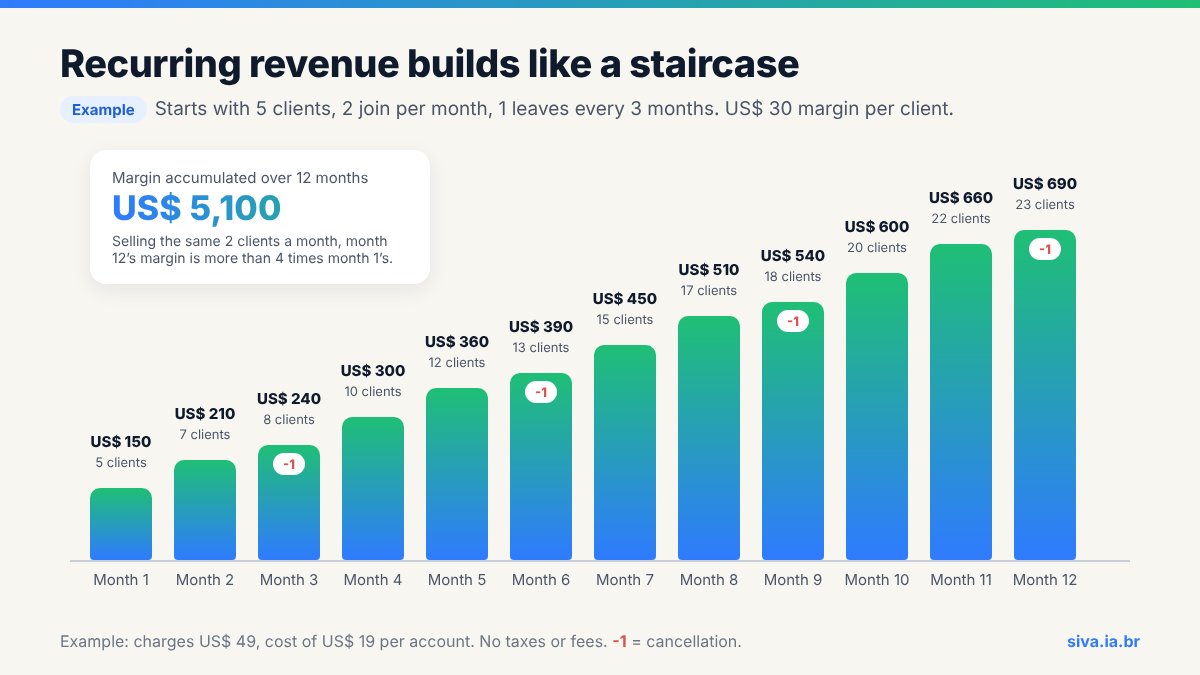
Example: a reseller starts with 5 clients, closes 2 new ones a month and loses 1 client every 3 months. Each client pays US$ 49 a month and the account costs US$ 19 at the provider, which leaves a margin of US$ 30 per client per month (before taxes and fees).
| Month | Active clients | Margin in the month (example) |
|---|---|---|
| Month 1 | 5 | US$ 150 |
| Month 3 | 8 | US$ 240 |
| Month 6 | 13 | US$ 390 |
| Month 9 | 18 | US$ 540 |
| Month 12 | 23 | US$ 690 |
Notice: in month 12 the reseller sells the same as in month 2 (two clients), but the month's margin is more than four times that of the first month. Adding up the 12 months of the example, the accumulated margin reaches US$ 5,100. To see the math with 5, 10 and 30 clients at two different prices, read how much you earn reselling AI customer service.
Affiliate, reselling under your brand or your own system: who owns the client
There are three common ways to earn every month with software, and the big difference is who owns the client:
| Model | Who owns the client | What you do |
|---|---|---|
| Affiliate or referral | The provider | You refer and receive whatever commission the provider sets |
| Reselling under your brand (white label) | You | You sell under your name, set the price, set up and follow up |
| Your own system (SaaS) | You | Everything, including coding, hosting, securing and updating the system |
If you already sell services to small businesses, reselling under your own brand is usually the middle ground: the client is yours and the price is yours, without building a development team. Learn more in what is white label software and compare the three paths in reseller, affiliate or build your own SaaS.
What keeps clients paying every month
Recurring revenue only exists while the client stays. In software, cancellation has a name: churn, the percentage of clients (or revenue) that leaves in a period. With high churn, the staircase stops climbing even when you sell well. In practice, small businesses tend to cancel when they don't see results, when the system sits unused or when nobody follows up with them.
- Proper setup: the client needs to see the system working in the first week, answering their own customers' real questions.
- Monitored usage: an account that stopped having conversations is an account about to cancel. Check who isn't using it before the client notices.
- Problems solved before the complaint: a disconnected WhatsApp, for example, needs to be reconnected the same day.
- Results shown: a monthly message with what the system did (conversations handled, appointments booked, orders) reminds the client why they pay.
In SIVA's partner program, the partner dashboard shows which accounts need attention: WhatsApp disconnected, 7 days without conversations or 80% of the AI quota used, with a daily summary by email. You can log into a client's account to help, resend the invite or pause the account. The dashboard and the emails are available in English or Spanish.
Tip: An example to keep in mind: if each client leaves you a US$ 30 margin per month and stays 12 months, that client is worth US$ 360 to you, not US$ 30. That's why keeping a client is often worth as much as winning a new one.
Step by step to build recurring revenue with software
- Pick a niche you already know: clinics, stores, real estate agencies, schools or the type of business you already serve. It's easier to speak the client's language.
- Define the price and what's included: monthly fee, setup and what you deliver alongside. See how to price white label software.
- Build a demo for the niche: a test account with real questions and answers from that type of business is more convincing than any presentation.
- Close your first 5 clients: start with your network and with businesses that already buy from you. See how to get your first clients.
- Automate billing: a due date, a payment link and automatic reconciliation keep you from becoming a debt collector. See how to charge clients automatically.
- Follow up and ask for referrals: a happy client refers another one in the same line of business, and that's what speeds up the staircase.
If you run ads or an agency, AI customer service fits what you already sell: the ad brings the conversation and the system answers instantly. See white label for marketing agencies.
Recurring revenue risks few people mention
- Minimum cost even with few clients: many providers charge a minimum. At SIVA, the partner invoice charges at least 5 accounts (US$ 95), so with 2 or 3 clients the margin is small.
- Dependence on the provider: the system is theirs. Before choosing, check stability, what you can customize and how billing works. Use the white label platform checklist.
- Late-paying clients: the provider charges you even if one of your clients pays late. At SIVA, if your invoice isn't paid by the due date, your clients' accounts are paused the next day (and come back on their own once you pay). Billing with reminders and pausing a client's account after a few days of delay reduce this risk.
- Support grows with your base: 30 clients ask more questions than 5. Build your support time into the price.
- Taxes and formalization: the monthly fees you receive are business income and, depending on your country, require invoices and taxes.
- Data protection: the conversations your clients have with their customers contain personal data. Laws such as the GDPR in Spain and the rest of Europe, and local laws in Latin America and India, set rules for handling it. Cover this in your contract.
Tip: This guide is informative only and doesn't replace an accountant or a lawyer. To register your business, choose how you'll pay taxes, comply with the data protection law in your country and write the contract with your clients, talk to a professional.
With SIVA, your recurring revenue starts with 5 clients and your brand
In SIVA's partner program, you resell the complete AI customer service system for WhatsApp under your name, your logo and your own address (like app.yourbrand.com). Each client account costs US$ 19 a month and you start with a pack of 5 accounts (US$ 95, which already covers their first month), with no entry fee and no setup fee. You pay by card through Stripe, your brand is created automatically and your access arrives by email. You set what you charge and the difference is yours. See what the system does on SIVA.
- You set each client's price; SIVA charges US$ 19 per active account, with a minimum of 5, billed in US dollars on the 1st and due on the 10th
- Charge your clients through your own Mercado Pago in Brazil, Mexico, Argentina, Colombia, Chile, Peru and Uruguay; anywhere else, charge your way and record the payment as “Received elsewhere”
- Dashboard with the accounts that need attention and a daily email summary to help you keep clients
- AI agent on WhatsApp 24/7, via QR code or the official Meta API, with 1,000 AI replies per account per month, all under your brand
FAQ
What is recurring revenue?
Money that comes in every month for the same service, without having to sell it again, like a subscription. In software, each client pays while they use the system.
Can I build recurring revenue with software without coding?
Yes. When you resell under your own brand (white label), the system is ready: you sell, set up and support your clients, and the provider handles the technology.
How many clients do I need for good recurring revenue?
It depends on your price and the cost per account. Example: with a US$ 30 margin per client, 20 clients bring in US$ 600 a month, before taxes and fees.
What is churn?
The percentage of clients, or revenue, that cancels in a period. With high churn, recurring revenue stops growing even when you sell well.
Is recurring revenue passive income?
Not entirely. It comes in without selling again, but it takes setup, support and follow-up for clients to keep paying.